How to Choose a Crane Operator School in Massachusetts
28
Aug
Choosing a crane operator school in Massachusetts is a licensing decision, a scheduling decision, and a job-readiness decision at the same time. The right program should connect your intended equipment classification with the Massachusetts exam. It should explain what training does and does not cover, and give you a realistic way to study around work.
Call 508-212-4735 to discuss the right training format.
The best crane operator school is the one that matches your Massachusetts classification, exam plan, learning style, and schedule. Online courses offer flexible access, classroom training provides direct instructor contact, and employer-sponsored training can coordinate preparation for multiple operators.
Do not choose by course format alone. Compare classification coverage, instructor support, application guidance, locations, language needs, and the provider's process for keeping course information current. This guide gives you a practical checklist for making that comparison.
What Should You Look for in a Massachusetts Crane Operator School?
Begin with fit, not convenience. A strong program should make it easy to identify the Massachusetts hoisting classification connected to your intended work. It should also distinguish course completion from the state licensing process, because finishing a class does not by itself grant a Massachusetts hoisting license.
Start with the equipment and classification
Write down the equipment you operate now and the equipment you expect to operate next. Then compare that list with the provider's course description. The Massachusetts license classification guide is a useful starting point because it helps you organize questions about the work and equipment covered by each classification.
This step matters for both new applicants and experienced operators adding a classification. A course that uses the broad phrase "crane training" may not address the exact classification, examination scope, or application path you need. Ask the school to identify those connections in plain language before you register.
Check exam preparation and current requirements
Massachusetts applicants should use current state guidance as the final authority for education and examination requirements. The official Massachusetts education requirements explain the written examination standard, including the minimum passing grade of 70 percent. The page also identifies national standard hand signals for the Crane and Excavator Examination.
A useful school will explain how its lessons support the exam without promising a licensing outcome. Ask whether the program addresses the rules, terminology, hand signals, equipment knowledge, and safety subjects you are expected to understand. You should leave the conversation knowing what the course prepares you to do and what remains your responsibility.
Look for support beyond a login
Online access is helpful, but support determines what happens when a technical question slows your preparation. Ask how students contact instructors, whether questions can be answered during the study period, and whether the school can explain an unfamiliar requirement without giving legal advice or making an eligibility decision for the state.
Application guidance is another useful service. MA Hoisting License's Massachusetts test application information can help you understand the administrative sequence. Still, the state decides eligibility and administers the examination. A provider should make that distinction clear rather than blending application assistance with state approval.
Which Crane Operator School Format Fits Your Schedule?
Format should solve a real constraint. Consider whether your main challenge is unpredictable shifts, travel time, the need to ask questions in real time, or the challenge of coordinating a whole crew. Each option has a different strength, and none should be treated as automatically best for every operator.
Crane operator training formats compared
| Format |
May fit operators who need |
Confirm before enrolling |
| Online |
Flexible study access around changing shifts |
Classification coverage, exam preparation, completion records, and instructor support |
| Classroom |
Direct instruction and a scheduled learning environment |
Location, dates, instructor access, course scope, and equipment classification |
| Employer-sponsored |
Coordinated preparation for several operators |
Crew classifications, jobsite logistics, language needs, and employer evaluation duties |
| Hybrid |
Self-paced review with planned instructor contact |
Which parts are online, when support occurs, and how completion is documented |
Choose online training when flexibility is the deciding factor
Online learning can work well for operators whose hours change from one week to the next. MA Hoisting License describes its online training as available 24/7, which lets students study when a shift ends or a project schedule changes. That access can remove travel and calendar friction.
Flexibility still requires a plan. Set recurring study blocks, keep a list of questions, and schedule time to revisit difficult material. Review the available online Massachusetts test preparation courses and confirm that the selected course addresses your classification and exam goal. A certificate of course completion is documentation of training, not the license itself.
Choose classroom training when direct feedback matters
Classroom training may be a better fit when you learn through discussion, want a fixed study schedule, or need an instructor to unpack technical material as you encounter it. A live setting gives you a defined time to ask about operating situations, safety procedures, terminology, and communication between the operator and ground personnel.
Location is part of the decision. MA Hoisting License offers classroom options, including Massachusetts classroom training for specific equipment paths. Confirm the current course date, center, classification, and included support before registering. Availability and course details can change, so use the live course page or call for the current information.
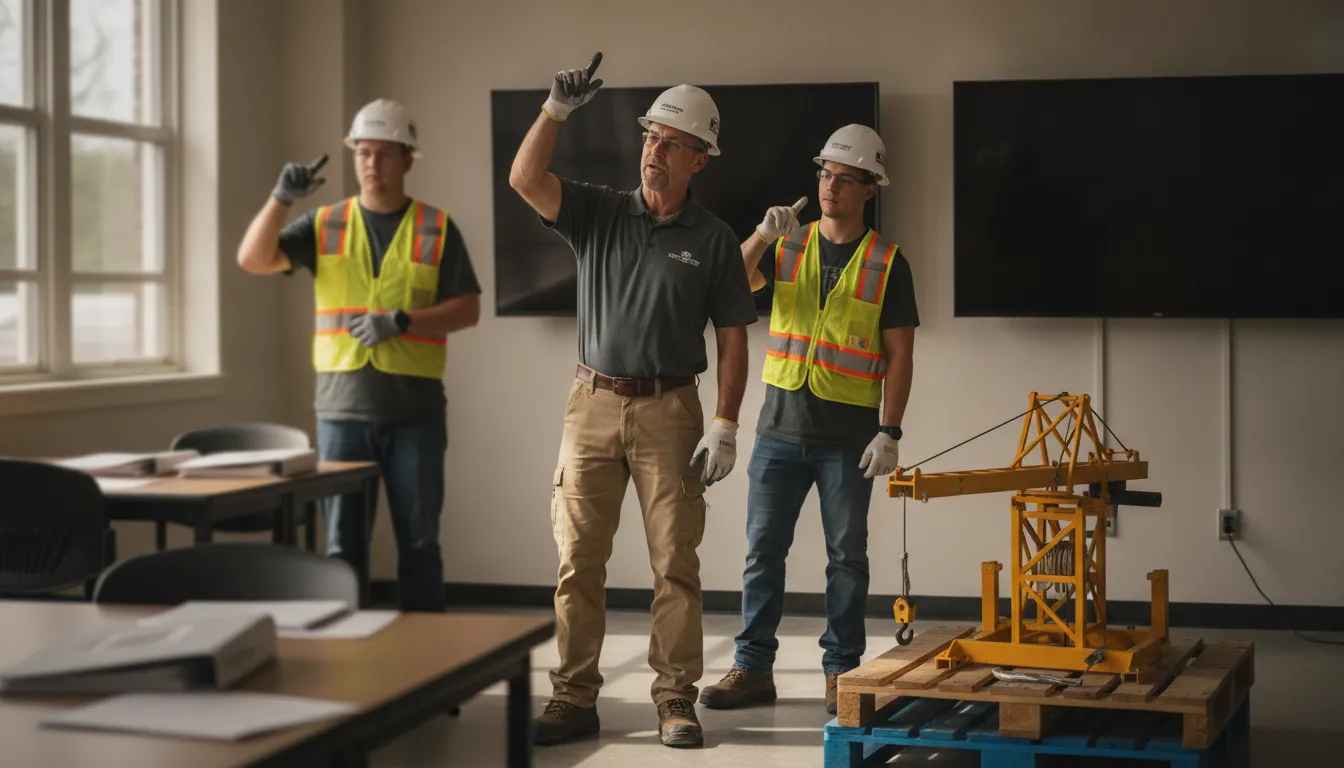
Choose employer-sponsored training when the crew is the unit
For a construction company, individual enrollment may not be the most efficient way to plan. Group training can help a manager coordinate multiple operators, but the plan should account for each person's classification and equipment assignment. One shared session does not automatically cover every machine or job duty.
Review the provider's group training options and ask how the school handles attendance, completion records, schedule changes, and language support. If an on-site format is more practical, compare the requirements for training at your location before choosing a delivery plan.
Business Owner Note: You can coordinate training for your crew around classifications, project schedules, and jobsite logistics instead of asking every employee to plan separately.
How Does an Online Crane Operator School Prepare You?
An online crane operator school can organize your review, but the results depend on how deliberately you use the material. Treat the course as a study system rather than a video playlist. Your plan should connect each lesson to the classification and Massachusetts exam requirements you are pursuing.
Online preparation works best when the course matches your classification, provides a clear completion record, and gives you a repeatable study schedule. It does not replace the state application, examination, or employer responsibilities tied to the equipment you operate.
Build a repeatable study schedule
Start by choosing study blocks you can protect. A short session after several shifts may be more realistic than an ambitious plan you cannot maintain. Keep notes on terms, hand signals, procedures, and questions that need clarification. At the end of each week, review what you can explain without looking at the lesson.
Use practice questions to find gaps, not to memorize a passing pattern. If a question exposes confusion about a classification or rule, return to the relevant lesson and verify the point against the current Massachusetts source. This approach is more useful than rushing through modules simply to mark them complete.
Know the limits of self-paced preparation
Self-paced learning may not be enough for someone new to crane work, an operator who needs immediate feedback, or a student who has difficulty building an independent routine. In those cases, classroom instruction or scheduled instructor support may remove more friction than online access creates.
There is also a difference between licensing preparation and employer qualification. Under OSHA's construction crane rule, employers must ensure operators are trained, certified or qualified, and evaluated for the equipment they operate. A course can support that process, but it does not eliminate the employer's separate duties.
When Is Classroom Crane Operator Training the Better Choice?
Classroom training is often the practical choice when a student wants a defined schedule and real-time explanation. It creates a place to compare questions, connect written requirements to jobsite decisions, and ask an instructor to clarify material before a misunderstanding becomes a study habit.
Choose classroom training when direct instructor access, scheduled study time, or discussion of technical material is more valuable to you than the convenience of learning anywhere. Confirm the classroom's location, dates, classification coverage, and current course details before enrolling.
Use instructor access for technical questions
Questions about equipment, communication, and safety procedures can be difficult to resolve from a short definition. In a classroom, an instructor can explain the reasoning behind a procedure and help you identify which topics require additional review. That conversation is especially useful when you are changing equipment types or preparing for a classification that differs from your current work.
Classroom discussion should reinforce, not replace, the official requirements. Ask the instructor to point you toward the current state source when a question involves eligibility, examination administration, or a changeable regulation. The goal is clear preparation without confusing training advice with an official state decision.
Plan the commute as part of the course
A convenient classroom is one you can attend consistently. Compare travel time with the dates offered, and consider how the commute interacts with shifts, weather, and project deadlines. MA Hoisting License maintains classroom locations in Massachusetts, including Plainville, Peabody, Worcester, Southbridge, and West Springfield. Confirm the current address and schedule on the live site before you commit.
If you need a particular course path, do not assume the closest center offers it on the date you want. Check the course page, ask about availability, and verify whether the planned instruction fits your intended classification. A realistic commute can matter more than a theoretical preference for classroom learning.
What Should Employers Ask Before Arranging Crew Training?
Employers should treat training selection as a workforce planning exercise. Before contacting a provider, list each operator's current role, intended equipment, Massachusetts classification, previous training, and target timeline. This prevents a company from selecting a single course that does not fit every employee.
- Map classifications to equipment. Identify the machines each operator will use and compare those duties with the relevant Massachusetts classification. Flag operators who need initial preparation, an additional classification, or renewal-related education.
- Choose the delivery format. Decide whether online, classroom, or on-site instruction best fits the crew's shifts and work locations. The best format may differ between a new operator and an experienced employee adding a classification.
- Set the schedule. Coordinate attendance, jobsite access, language needs, and project deadlines before the first session. If the crew includes Spanish-speaking workers, ask about available Spanish-language training rather than assuming English-only materials are sufficient.
- Track each person's progress. Keep completion records, application steps, exam plans, and outstanding questions separate for each operator. A group schedule does not create one shared license or one shared qualification.
- Plan the post-course evaluation. OSHA's employer duties continue after a course ends. Build a process for evaluating each operator on the specific equipment they will use, documenting the result, and updating authorization when assignments change.
Managers can also compare in-house training support with a classroom schedule. Ask the provider what the jobsite must supply and which portions of the program address state licensing preparation versus employer-specific evaluation.
Call 508-212-4735 to discuss enrollment and choose a training format.
How Do You Confirm a School's Application and Credential Fit?
Use a short verification process before you pay, schedule time away from work, or recommend a provider to your crew. The purpose is to prevent a convenient course from creating a mismatch later.
Confirm four items in writing: the Massachusetts classification covered, the exam preparation included, the application guidance available, and the credential produced at completion. Then compare those items with the job and equipment you expect to perform.
Ask what the course covers
Request the course title, classification, delivery format, schedule, instructor support, and completion documentation. If the page uses a broad phrase such as "crane operator," ask which equipment and exam topics are actually included. Save the course page or enrollment details so you can refer back to the same description.
Separate training from state approval
Training providers can teach, organize preparation, and explain application steps. The Commonwealth controls the licensing process and examination. Read the current state requirements and use the state's instructions when a question involves eligibility, official forms, examination administration, or regulatory interpretation.
Compare support with your learning needs
Ask yourself what would cause you to stop studying. If the answer is travel, online access may remove the obstacle. If it is uncertainty, direct instructor support may help more. If it is coordinating several employees, group or on-site training may be the practical route. The best decision addresses the problem most likely to derail completion.
What Questions Should You Ask Before Enrolling?
Use these questions during a call or enrollment review. A clear answer is more valuable than a polished course label.
- Which Massachusetts classification and equipment does this course cover?
- How does the material support the written state examination?
- What instructor support is available during and after the course?
- What record or certificate confirms course completion?
- Which application steps are explained, and which decisions remain with the state?
- Can I study online, attend a classroom, or arrange instruction for a crew?
- Are the location, dates, language support, and course details current?
- What employer evaluation responsibilities remain after training?
For a broader view of current site resources, visit the MA Hoisting License blog. Use topic-specific course pages for enrollment decisions, and return to official Massachusetts sources for licensing requirements that may change.
Frequently Asked Questions
Is an online crane operator school enough for a Massachusetts license?
Online training can support preparation, but completing a course does not by itself issue a Massachusetts hoisting license. Confirm your classification, follow the state application process, and prepare for the required examination. Check that the course offers the instructor support and subject coverage you need.
When should I choose classroom crane operator training?
Choose classroom training when you learn best through real-time discussion, need a fixed study schedule, or want direct help with technical material. Before registering, verify the location, dates, classification coverage, and current course details on the provider's live page.
Can an employer arrange training for an entire crane crew?
Yes. An employer can discuss group or on-site training for multiple operators. The plan should still match each employee's equipment and classification, track individual completion, and preserve the employer's separate responsibility to evaluate operators for the equipment they operate.
Is NCCCO certification the same as a Massachusetts hoisting license?
No. NCCCO certification and a Massachusetts hoisting license are separate credentials with different issuing processes. If an employer requests both, ask the school to identify which course addresses each requirement. Review the NCCCO certification information and current Massachusetts guidance separately.
What is the first question to ask a crane operator school?
Ask which Massachusetts classification and equipment the course covers. That answer determines whether the exam preparation, instructor support, format, and application guidance are relevant to the work you plan to perform.
Ready to Choose Your Training Format?
Once you know the classification and exam path, compare the format that fits your actual schedule. MA Hoisting License offers online and classroom options, multiple Massachusetts locations, and group training resources for employers. Review the relevant course page, verify current details, and ask for help if you are unsure which path fits your equipment and goals.
Call 508-212-4735 to discuss enrollment and choose your training format.
Choosing a crane operator school in Massachusetts is a licensing decision, a scheduling decision, and a job-readiness decision at the same time. The right program should connect your intended equipment classification with the Massachusetts exam. It should explain what training does and does not cover, and give you a realistic way to study around work.
Call 508-212-4735 to discuss the right training format.
The best crane operator school is the one that matches your Massachusetts classification, exam plan, learning style, and schedule. Online courses offer flexible access, classroom training provides direct instructor contact, and employer-sponsored training can coordinate preparation for multiple operators.
Do not choose by course format alone. Compare classification coverage, instructor support, application guidance, locations, language needs, and the provider's process for keeping course information current. This guide gives you a practical checklist for making that comparison.
What Should You Look for in a Massachusetts Crane Operator School?
Begin with fit, not convenience. A strong program should make it easy to identify the Massachusetts hoisting classification connected to your intended work. It should also distinguish course completion from the state licensing process, because finishing a class does not by itself grant a Massachusetts hoisting license.
Start with the equipment and classification
Write down the equipment you operate now and the equipment you expect to operate next. Then compare that list with the provider's course description. The Massachusetts license classification guide is a useful starting point because it helps you organize questions about the work and equipment covered by each classification.
This step matters for both new applicants and experienced operators adding a classification. A course that uses the broad phrase "crane training" may not address the exact classification, examination scope, or application path you need. Ask the school to identify those connections in plain language before you register.
Check exam preparation and current requirements
Massachusetts applicants should use current state guidance as the final authority for education and examination requirements. The official Massachusetts education requirements explain the written examination standard, including the minimum passing grade of 70 percent. The page also identifies national standard hand signals for the Crane and Excavator Examination.
A useful school will explain how its lessons support the exam without promising a licensing outcome. Ask whether the program addresses the rules, terminology, hand signals, equipment knowledge, and safety subjects you are expected to understand. You should leave the conversation knowing what the course prepares you to do and what remains your responsibility.
Look for support beyond a login
Online access is helpful, but support determines what happens when a technical question slows your preparation. Ask how students contact instructors, whether questions can be answered during the study period, and whether the school can explain an unfamiliar requirement without giving legal advice or making an eligibility decision for the state.
Application guidance is another useful service. MA Hoisting License's Massachusetts test application information can help you understand the administrative sequence. Still, the state decides eligibility and administers the examination. A provider should make that distinction clear rather than blending application assistance with state approval.
Which Crane Operator School Format Fits Your Schedule?
Format should solve a real constraint. Consider whether your main challenge is unpredictable shifts, travel time, the need to ask questions in real time, or the challenge of coordinating a whole crew. Each option has a different strength, and none should be treated as automatically best for every operator.
Crane operator training formats compared
| Format |
May fit operators who need |
Confirm before enrolling |
| Online |
Flexible study access around changing shifts |
Classification coverage, exam preparation, completion records, and instructor support |
| Classroom |
Direct instruction and a scheduled learning environment |
Location, dates, instructor access, course scope, and equipment classification |
| Employer-sponsored |
Coordinated preparation for several operators |
Crew classifications, jobsite logistics, language needs, and employer evaluation duties |
| Hybrid |
Self-paced review with planned instructor contact |
Which parts are online, when support occurs, and how completion is documented |
Choose online training when flexibility is the deciding factor
Online learning can work well for operators whose hours change from one week to the next. MA Hoisting License describes its online training as available 24/7, which lets students study when a shift ends or a project schedule changes. That access can remove travel and calendar friction.
Flexibility still requires a plan. Set recurring study blocks, keep a list of questions, and schedule time to revisit difficult material. Review the available online Massachusetts test preparation courses and confirm that the selected course addresses your classification and exam goal. A certificate of course completion is documentation of training, not the license itself.
Choose classroom training when direct feedback matters
Classroom training may be a better fit when you learn through discussion, want a fixed study schedule, or need an instructor to unpack technical material as you encounter it. A live setting gives you a defined time to ask about operating situations, safety procedures, terminology, and communication between the operator and ground personnel.
Location is part of the decision. MA Hoisting License offers classroom options, including Massachusetts classroom training for specific equipment paths. Confirm the current course date, center, classification, and included support before registering. Availability and course details can change, so use the live course page or call for the current information.
Choose employer-sponsored training when the crew is the unit
For a construction company, individual enrollment may not be the most efficient way to plan. Group training can help a manager coordinate multiple operators, but the plan should account for each person's classification and equipment assignment. One shared session does not automatically cover every machine or job duty.
Review the provider's group training options and ask how the school handles attendance, completion records, schedule changes, and language support. If an on-site format is more practical, compare the requirements for training at your location before choosing a delivery plan.
Business Owner Note: You can coordinate training for your crew around classifications, project schedules, and jobsite logistics instead of asking every employee to plan separately.
How Does an Online Crane Operator School Prepare You?
An online crane operator school can organize your review, but the results depend on how deliberately you use the material. Treat the course as a study system rather than a video playlist. Your plan should connect each lesson to the classification and Massachusetts exam requirements you are pursuing.
Online preparation works best when the course matches your classification, provides a clear completion record, and gives you a repeatable study schedule. It does not replace the state application, examination, or employer responsibilities tied to the equipment you operate.
Build a repeatable study schedule
Start by choosing study blocks you can protect. A short session after several shifts may be more realistic than an ambitious plan you cannot maintain. Keep notes on terms, hand signals, procedures, and questions that need clarification. At the end of each week, review what you can explain without looking at the lesson.
Use practice questions to find gaps, not to memorize a passing pattern. If a question exposes confusion about a classification or rule, return to the relevant lesson and verify the point against the current Massachusetts source. This approach is more useful than rushing through modules simply to mark them complete.
Know the limits of self-paced preparation
Self-paced learning may not be enough for someone new to crane work, an operator who needs immediate feedback, or a student who has difficulty building an independent routine. In those cases, classroom instruction or scheduled instructor support may remove more friction than online access creates.
There is also a difference between licensing preparation and employer qualification. Under OSHA's construction crane rule, employers must ensure operators are trained, certified or qualified, and evaluated for the equipment they operate. A course can support that process, but it does not eliminate the employer's separate duties.
When Is Classroom Crane Operator Training the Better Choice?
Classroom training is often the practical choice when a student wants a defined schedule and real-time explanation. It creates a place to compare questions, connect written requirements to jobsite decisions, and ask an instructor to clarify material before a misunderstanding becomes a study habit.
Choose classroom training when direct instructor access, scheduled study time, or discussion of technical material is more valuable to you than the convenience of learning anywhere. Confirm the classroom's location, dates, classification coverage, and current course details before enrolling.
Use instructor access for technical questions
Questions about equipment, communication, and safety procedures can be difficult to resolve from a short definition. In a classroom, an instructor can explain the reasoning behind a procedure and help you identify which topics require additional review. That conversation is especially useful when you are changing equipment types or preparing for a classification that differs from your current work.
Classroom discussion should reinforce, not replace, the official requirements. Ask the instructor to point you toward the current state source when a question involves eligibility, examination administration, or a changeable regulation. The goal is clear preparation without confusing training advice with an official state decision.
Plan the commute as part of the course
A convenient classroom is one you can attend consistently. Compare travel time with the dates offered, and consider how the commute interacts with shifts, weather, and project deadlines. MA Hoisting License maintains classroom locations in Massachusetts, including Plainville, Peabody, Worcester, Southbridge, and West Springfield. Confirm the current address and schedule on the live site before you commit.
If you need a particular course path, do not assume the closest center offers it on the date you want. Check the course page, ask about availability, and verify whether the planned instruction fits your intended classification. A realistic commute can matter more than a theoretical preference for classroom learning.
What Should Employers Ask Before Arranging Crew Training?
Employers should treat training selection as a workforce planning exercise. Before contacting a provider, list each operator's current role, intended equipment, Massachusetts classification, previous training, and target timeline. This prevents a company from selecting a single course that does not fit every employee.
- Map classifications to equipment. Identify the machines each operator will use and compare those duties with the relevant Massachusetts classification. Flag operators who need initial preparation, an additional classification, or renewal-related education.
- Choose the delivery format. Decide whether online, classroom, or on-site instruction best fits the crew's shifts and work locations. The best format may differ between a new operator and an experienced employee adding a classification.
- Set the schedule. Coordinate attendance, jobsite access, language needs, and project deadlines before the first session. If the crew includes Spanish-speaking workers, ask about available Spanish-language training rather than assuming English-only materials are sufficient.
- Track each person's progress. Keep completion records, application steps, exam plans, and outstanding questions separate for each operator. A group schedule does not create one shared license or one shared qualification.
- Plan the post-course evaluation. OSHA's employer duties continue after a course ends. Build a process for evaluating each operator on the specific equipment they will use, documenting the result, and updating authorization when assignments change.
Managers can also compare in-house training support with a classroom schedule. Ask the provider what the jobsite must supply and which portions of the program address state licensing preparation versus employer-specific evaluation.
Call 508-212-4735 to discuss enrollment and choose a training format.
How Do You Confirm a School's Application and Credential Fit?
Use a short verification process before you pay, schedule time away from work, or recommend a provider to your crew. The purpose is to prevent a convenient course from creating a mismatch later.
Confirm four items in writing: the Massachusetts classification covered, the exam preparation included, the application guidance available, and the credential produced at completion. Then compare those items with the job and equipment you expect to perform.
Ask what the course covers
Request the course title, classification, delivery format, schedule, instructor support, and completion documentation. If the page uses a broad phrase such as "crane operator," ask which equipment and exam topics are actually included. Save the course page or enrollment details so you can refer back to the same description.
Separate training from state approval
Training providers can teach, organize preparation, and explain application steps. The Commonwealth controls the licensing process and examination. Read the current state requirements and use the state's instructions when a question involves eligibility, official forms, examination administration, or regulatory interpretation.
Compare support with your learning needs
Ask yourself what would cause you to stop studying. If the answer is travel, online access may remove the obstacle. If it is uncertainty, direct instructor support may help more. If it is coordinating several employees, group or on-site training may be the practical route. The best decision addresses the problem most likely to derail completion.
What Questions Should You Ask Before Enrolling?
Use these questions during a call or enrollment review. A clear answer is more valuable than a polished course label.
- Which Massachusetts classification and equipment does this course cover?
- How does the material support the written state examination?
- What instructor support is available during and after the course?
- What record or certificate confirms course completion?
- Which application steps are explained, and which decisions remain with the state?
- Can I study online, attend a classroom, or arrange instruction for a crew?
- Are the location, dates, language support, and course details current?
- What employer evaluation responsibilities remain after training?
For a broader view of current site resources, visit the MA Hoisting License blog. Use topic-specific course pages for enrollment decisions, and return to official Massachusetts sources for licensing requirements that may change.
Frequently Asked Questions
Is an online crane operator school enough for a Massachusetts license?
Online training can support preparation, but completing a course does not by itself issue a Massachusetts hoisting license. Confirm your classification, follow the state application process, and prepare for the required examination. Check that the course offers the instructor support and subject coverage you need.
When should I choose classroom crane operator training?
Choose classroom training when you learn best through real-time discussion, need a fixed study schedule, or want direct help with technical material. Before registering, verify the location, dates, classification coverage, and current course details on the provider's live page.
Can an employer arrange training for an entire crane crew?
Yes. An employer can discuss group or on-site training for multiple operators. The plan should still match each employee's equipment and classification, track individual completion, and preserve the employer's separate responsibility to evaluate operators for the equipment they operate.
Is NCCCO certification the same as a Massachusetts hoisting license?
No. NCCCO certification and a Massachusetts hoisting license are separate credentials with different issuing processes. If an employer requests both, ask the school to identify which course addresses each requirement. Review the NCCCO certification information and current Massachusetts guidance separately.
What is the first question to ask a crane operator school?
Ask which Massachusetts classification and equipment the course covers. That answer determines whether the exam preparation, instructor support, format, and application guidance are relevant to the work you plan to perform.
Ready to Choose Your Training Format?
Once you know the classification and exam path, compare the format that fits your actual schedule. MA Hoisting License offers online and classroom options, multiple Massachusetts locations, and group training resources for employers. Review the relevant course page, verify current details, and ask for help if you are unsure which path fits your equipment and goals.
Call 508-212-4735 to discuss enrollment and choose your training format.
Tags: ,