Crane Hand Signals: A Complete Guide for MA Operators
20
Aug
On a busy Massachusetts hoisting site, a clear signal can keep a routine lift controlled when the operator cannot see the load or its travel path. The person directing the lift must communicate deliberately, and everyone involved must understand what each movement means before equipment starts moving.
Call 508-212-4735 to enroll today.
Crane hand signals are standardized visual instructions for movements such as hoisting, lowering, swinging, stopping, and traveling. OSHA requires the standard method when hand signals are used, and a signal person is required when the operator cannot see the point of operation or load-travel area. Learning these signals helps operators prepare for the Massachusetts hoisting license exam and communicate safely on the job.
This guide explains the core signals, who may give them, and what to do when communication is interrupted. Start with the rules that make signaling reliable, because recognizing a gesture is only useful when the entire crew follows the same communication plan.
Why Crane Hand Signals Matter on a Massachusetts Job Site
A crane operator cannot make a safe lift based on guesswork. When the operator cannot see the load travel area, the point of operation. Or the area near load placement in full view, OSHA requires a signal person to be provided. That person gives the operator a clear line of communication about movement, clearance, and placement. This matters on Massachusetts job sites where buildings, materials, equipment, and workers can quickly obstruct the operator's view. See the OSHA signaling requirements for the governing construction standard.
Standard Massachusetts hoisting license training helps operators and signal people build the practical knowledge needed to communicate during a lift. The goal is not to memorize gestures in isolation. Every signal must be recognized, deliberate, and understood before the load moves.
One signal person keeps the message clear
Only one person may give signals to the crane or derrick at a time, except in the specific emergency circumstances addressed by the OSHA rule. If several workers wave or call instructions at once, the operator has no reliable way to determine which direction or action is intended. The designated signal person should be identified before the lift, remain visible or connected through the agreed communication method, and give signals that are easy to distinguish.
This single-source approach is especially important when the load is moving behind a structure, over a blind area, or into a crowded placement zone. The signal person must account for the work area and communicate deliberately instead of reacting with improvised motions. OSHA requires the standard method when hand signals are used. Which gives crews a consistent language across jobsites and reduces misunderstandings between the operator and the person directing the load.
Stop the lift when communication is interrupted
Communication is a safety control, not a convenience. If the operator can no longer see or understand the signal person. Operations requiring signals must stop safely until communication is reestablished and a proper signal is given and understood. The same principle applies when the operator identifies a safety problem and needs to communicate about it. The lift should not resume until the concern is resolved and both parties agree on the plan.
That pause may feel inconvenient when a crew is working under schedule pressure, but continuing without a clear signal creates unnecessary uncertainty around a suspended load. Review the standard signals before the shift, confirm who is directing the operation, and stop immediately when visibility, attention, or understanding is lost.
Who Can Give Signals: OSHA Requirements for a Qualified Signal Person
A signal person is not simply the worker closest to the crane. The role carries a specific safety responsibility, and OSHA requires one when the point of operation. Load travel area, or load-placement area is not in the operator's full view. A signal person is also required when equipment is traveling and the operator's view in the direction of travel is obstructed. These conditions can occur even on a familiar job site, particularly around buildings, trenches, materials, or other equipment. See OSHA 1926.1419 for the governing construction standard.
The signal person and operator must be able to transmit and understand signals throughout the operation. If communication is interrupted, the operator must safely stop operations that require signals until communication is restored and a proper signal is given and understood. Only one person may give signals to the crane or derrick at a time, except in the limited circumstances addressed by the standard. This prevents competing instructions from reaching the operator.
What must qualification documentation show?
Employers must make documentation of the signal person's qualifications available at the worksite. Paper and electronic records are both acceptable. The record must identify the types of signaling the person is qualified to perform, such as hand signals or radio signals. A general statement that someone is a qualified worker may not tell the crew or an inspector whether that person is qualified for the communication method being used.
OSHA's signal-person factsheet explains that the qualification documentation may be issued by a third-party qualified evaluator or by the employer's own qualified evaluator. The evaluator and employer should ensure the record matches the person's assigned signaling duties. Keep the documentation accessible before the lift begins, not somewhere that requires a delay or guesswork to retrieve. The OSHA signal-person factsheet summarizes these documentation requirements.
How should crews handle non-standard signals?
OSHA's standard method should be used for hand signals unless a different method is appropriate under the rule. If non-standard hand signals will be used, the signal person, crane operator, and lift director. When there is one, must contact each other before the operation and agree on the signals. Do not improvise a movement signal after the load is suspended. Discuss the meaning, confirm that everyone understands it, and use a communication method suited to the site conditions.
For operators and employers preparing for Massachusetts licensing or workplace assignments, state-approved hoisting training courses can help connect the regulation to the signals used in real lifts. Qualification records, clear assignments, and disciplined communication are the practical checks that make a signal plan usable when visibility is limited.
The Standard Crane Hand Signals You Need for the Exam
Massachusetts hoisting exam preparation should include the standard crane hand signals in OSHA 1926 Subpart CC, Appendix A. These signals create a shared visual language between the operator and signal person, especially when the operator cannot see the load path or placement area. OSHA requires the Standard Method when hand signals are used, unless an alternative method is appropriate and properly agreed upon before the lift. Review both the signal name and the required arm, hand, or finger movement. On an exam question and on a job site, the difference between a normal stop and an emergency stop matters.
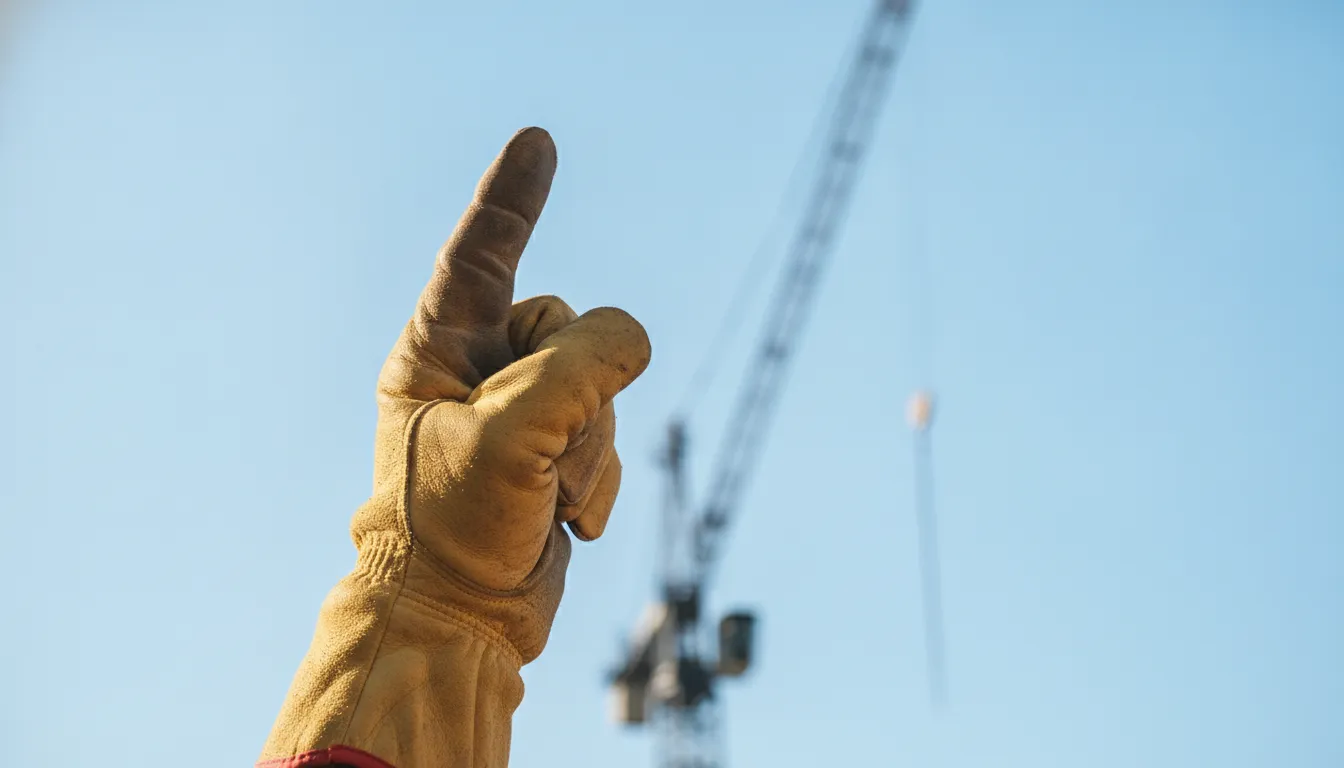
The table below summarizes the standard signals named in Appendix A. The official illustrations remain the controlling reference for the exact motion and position.
OSHA standard crane hand signals from 1926 Subpart CC Appendix A| Signal | One-line description |
|---|
| STOP | Extend one arm horizontally, palm down, and move the arm back and forth. |
|---|
| EMERGENCY STOP | Extend both arms horizontally, palms down, and move both arms back and forth. |
|---|
| HOIST | With the forearm vertical and index finger pointing up, move the hand in a small horizontal circle. |
|---|
| RAISE BOOM | Extend the arm horizontally, thumb up, and flex the fingers inward and outward. |
|---|
| SWING | Extend the arm horizontally in the direction of swing, with the palm down. |
|---|
| LOWER | With the arm and forearm extended downward, move the hand in a small horizontal circle. |
|---|
| LOWER BOOM | Extend the arm horizontally, thumb down, and flex the fingers inward and outward. |
|---|
| DOG EVERYTHING | Clasp both hands in front of the body. |
|---|
| TRAVEL | Extend the arm forward, palm up, and push the hand in the direction of travel. |
|---|
| MOVE SLOWLY | Use one hand to give the movement signal while placing the other hand motionless in front of it. |
|---|
| USE MAIN HOIST | Tap the top of the head with a closed fist. |
|---|
| USE AUXILIARY HOIST | Tap the elbow of the arm being used to signal with the opposite hand. |
|---|
| RETRACT TELESCOPING BOOM | Place both fists in front of the body with thumbs pointing toward each other. |
|---|
| EXTEND TELESCOPING BOOM | Place both fists in front of the body with thumbs pointing away from each other. |
|---|
OSHA's signal requirements also establish basic communication controls. Only one person should give signals to the crane at a time, and operations requiring signals must stop if communication is interrupted. The operator and signal person must reestablish communication before the lift continues. Memorizing the names without practicing the motions is not enough. Study the official Appendix A signal illustrations, then practice identifying each signal from the operator's viewpoint and from a distance.
How to Signal Boom and Load Movement Like a Pro
Movement signals must be deliberate, visible, and understood before the operator acts. Practice each motion with your arm fully extended, keep your body in a safe position, and hold the signal long enough for the operator to confirm it. The descriptions below follow the Standard Method in OSHA's construction rules and its Appendix A hand-signal chart. Review OSHA's signal requirements alongside your Massachusetts hoisting license study materials.
- Raise the boom. Extend one arm horizontally, close your hand into a fist, and point your thumb upward. This tells the operator to raise the boom, not to lift the load. The upward thumb is the key visual cue. OSHA Appendix A identifies this as the standard "raise boom" signal, and the same description is summarized in the signal reference used for this guide.
- Lower the boom. Extend your arm horizontally, make a fist, and point your thumb downward. Keep the arm steady while the boom moves. Do not combine this with a load signal unless you intentionally give the combined command described below.
- Hoist, or raise the load. Point your index finger upward with your forearm vertical, then make small circles with the finger. The circular motion distinguishes a load-raising command from the simple thumb-up signal for raising the boom.
- Lower the load. Point your index finger downward and make small circles. Keep the motion controlled and easy to see. A downward-pointing finger with circles means lower the load, while a plain thumb-down signal means lower the boom.
- Swing the boom. Extend your arm in the direction you want the boom to travel and point with your index finger. The direction of your arm and finger gives the operator the intended swing direction. Stand where you remain visible without entering the swing radius or the load's path.
- Use a combined signal when two movements must occur together. For "raise boom and lower load," use the standard raise-boom signal with one hand while pointing the other index finger down and making small circles. For the reverse command, "lower boom and raise load," combine the thumb-down boom signal with the upward-pointing finger and small circles. Keep the two hand positions distinct so the operator can read both commands.
- Confirm before continuing. If the operator cannot see the signal clearly, the line of sight changes, or communication is interrupted, stop the operation and reestablish a proper signal before movement resumes. OSHA requires the operator to safely stop operations requiring signals when communication is interrupted. These movement commands, and the ability to distinguish them quickly, are commonly included in Massachusetts hoisting license exam preparation.
Do not improvise a signal because a movement seems obvious. Standard crane hand signals create a shared language between the operator and signal person. Rehearse boom direction, load direction, and combined commands until each can be given without hesitation.
How Are Crane Hand Signals Tested on the Massachusetts Hoisting License Exam?
The Massachusetts hoisting license exam is a written examination administered by the Office of Public Safety and Inspections (OPSI). You need a score of at least 70 percent to pass. Questions cover equipment operation, safety, and regulations, so crane hand signals are not a side topic to memorize only if time allows. They are part of the operating knowledge expected from a licensed crane operator.
In practical terms, exam preparation should teach you to recognize the standard signal, connect it to the requested crane movement, and understand when communication must stop. The test assesses your knowledge of standard hand signals used by crane operators and signal persons. That means studying the meaning of each signal matters more than memorizing an isolated picture without understanding the operation behind it.
What the written exam is testing
Expect the hand-signal material to fit within a broader safety and operations context. You should be able to distinguish signals for hoisting, lowering, boom movement, swinging, traveling, stopping, and emergency stopping. Pay close attention to signals that look similar but direct different movements. Confusing boom up with boom down, or a regular stop with an emergency stop. Can create a serious job-site hazard even when the operator and signal person are otherwise experienced.
Review the standard method in the OSHA construction crane rule, 29 CFR 1926.1419, and its signal illustrations in Appendix A. OSHA states that the standard method must be used when hand signals are used, unless the applicable conditions make another method necessary. The rule also requires a signal person when the operator cannot see the point of operation or load travel area. And it limits signaling to one person at a time in ordinary circumstances. See the OSHA crane signaling requirements for the regulatory language.
How to study for signal questions
Use a signal chart as an active study tool. Cover the description and identify the movement from the illustration. Then reverse the exercise: read a movement such as "lower the load" or "stop" and recall the correct signal. Say the movement out loud as you practice. This builds the same operator-signal-person vocabulary that you need when equipment is moving and visibility is limited.
Do not study signals separately from their safety rules. If communication is interrupted, OSHA requires the operator to safely stop operations requiring signals until communication is reestablished and a proper signal is given and understood. If an operator sees a safety problem, operations must also stop until the issue is resolved. These rules show why signal knowledge is tested: standardized communication supports both correct equipment movement and the authority to stop a lift.
Before enrolling, review the Class 1 hoisting license requirements or the classification that matches your work. A focused Massachusetts hoisting course should connect written exam preparation with the daily discipline of clear, standard signals on the job site.
Call 508-212-4735 to start your hoisting license training.
Frequently Asked Questions
Are standard hand signals required for crane operations?
When hand signals are used, OSHA requires the Standard Method in Appendix A of Subpart CC unless an approved alternative is appropriate. A signal person is also required when the load travel or placement area is not in the operator's full view. Review the current rule at OSHA 1926.1419.
What should the operator do if a signal is unclear or communication stops?
The operator should safely stop operations that require signals. Work must not resume until communication is restored and a proper signal is given and understood. If the operator identifies a safety problem, the lift also stays stopped until the operator and signal person agree that the issue is resolved.
How do you signal boom up and boom down?
For boom up, extend an arm to the side, point the thumb upward, and close the fingers into a fist. For boom down, extend the arm and point the thumb downward. Practice both directions until the movement is unmistakable, then confirm the signal language during the pre-lift briefing.
Can more than one person give signals to the crane operator?
Only one person may give signals to the crane or derrick at a time, except in the specific emergency circumstances addressed by OSHA. The crew should identify that signal person before the lift, and the employer must keep qualification documentation available at the worksite, in paper or electronic form. See the OSHA signal person factsheet.
Ready to Enroll in Massachusetts Hoisting Training?
Accurate crane hand signals support safer coordination during hoisting operations and help you prepare for the Massachusetts hoisting license exam. Build practical knowledge through MA Hoisting License training, with guidance focused on the skills operators need in the field and on test day.
Call 508-212-4735 to enroll at MA Hoisting License.
Tags: ,