Rigging Certification in Massachusetts: Roles and Rules
02
Sep
A Massachusetts jobsite may involve a hoisting license holder, a rigger, and a signal person, but those roles are not interchangeable. The right training depends on the equipment being used, the work each person performs, and the employer or project requirements that apply. This guide explains how to evaluate those requirements before choosing training.
Call 508-212-4735 to discuss the right training path.
In Massachusetts, rigging certification may refer to a third-party credential, an employer qualification, or role-specific training. OSHA does not require one universal rigger certificate, but employers must ensure personnel are qualified for assigned work, including safe rigging practices covered by 29 CFR 1926.251. A state hoisting license addresses regulated equipment operation and does not automatically qualify someone for every rigging or signaling duty.
Start by separating the state licensing framework from the practical qualifications required for lifting, connecting, directing, inspecting, and communicating around a load. That distinction makes the next training decision much clearer.
What Does Rigging Certification Mean in Massachusetts?
"Rigging certification" is not always the name of one Massachusetts license. Depending on the job, it may describe a third-party rigger credential, a signal-person qualification, documented employer training, or an employer's determination that a worker has the knowledge and experience to perform assigned lifting tasks safely. Those distinctions matter because a credential that supports one role may not authorize every activity on a construction site.
OSHA describes a qualified rigger as someone with the combination of training, knowledge, and experience needed to perform the necessary work safely. OSHA does not establish one universal formal certification card for every rigger. Instead, employers must ensure that personnel are qualified for the work they are assigned to perform. Requirements can also be shaped by the equipment, the lift plan, the employer, the general contractor, or the project owner.
For material-handling work, OSHA 29 CFR 1926.251 addresses rigging equipment and related safeguards. Crane and derrick work may also involve OSHA 29 CFR 1926 Subpart CC. These federal rules are separate from any state license or industry credential. They help define safe work expectations, but they do not turn a general training course into automatic authorization for every lift.
Massachusetts has its own hoisting-license framework. The Office of Public Safety and Inspections oversees licensing under Massachusetts General Laws Chapter 146 and 520 CMR 6.00. The state system uses equipment classifications, including Class 1 hoisting equipment, Class 2 excavating equipment, Class 3 special equipment, and Class 4 specialty operations. The applicable classification depends on the equipment and operation, so review the Massachusetts hoisting license classifications before choosing preparation.
A Massachusetts hoisting license can be important when a worker operates equipment covered by the state framework. It should not be represented as a substitute for every rigger or signal-person qualification. A rigger may select, inspect, and attach lifting equipment. A signal person may direct a crane operator through an agreed communication system. An operator may need a state hoisting license for the equipment being operated. One person may hold more than one responsibility, but each responsibility still requires the appropriate training and qualification.
Start by writing down the equipment, the worker's exact duties, the type of loads, and the employer or project requirements. Then confirm the current OSHA and Massachusetts requirements that apply. If the work involves operating covered hoisting equipment, use the classification information and current OPSI guidance as the basis for the licensing decision rather than searching for a generic "rigging certification" label.
Rigger, Signal Person, or Hoisting-License Holder: Who Does What?
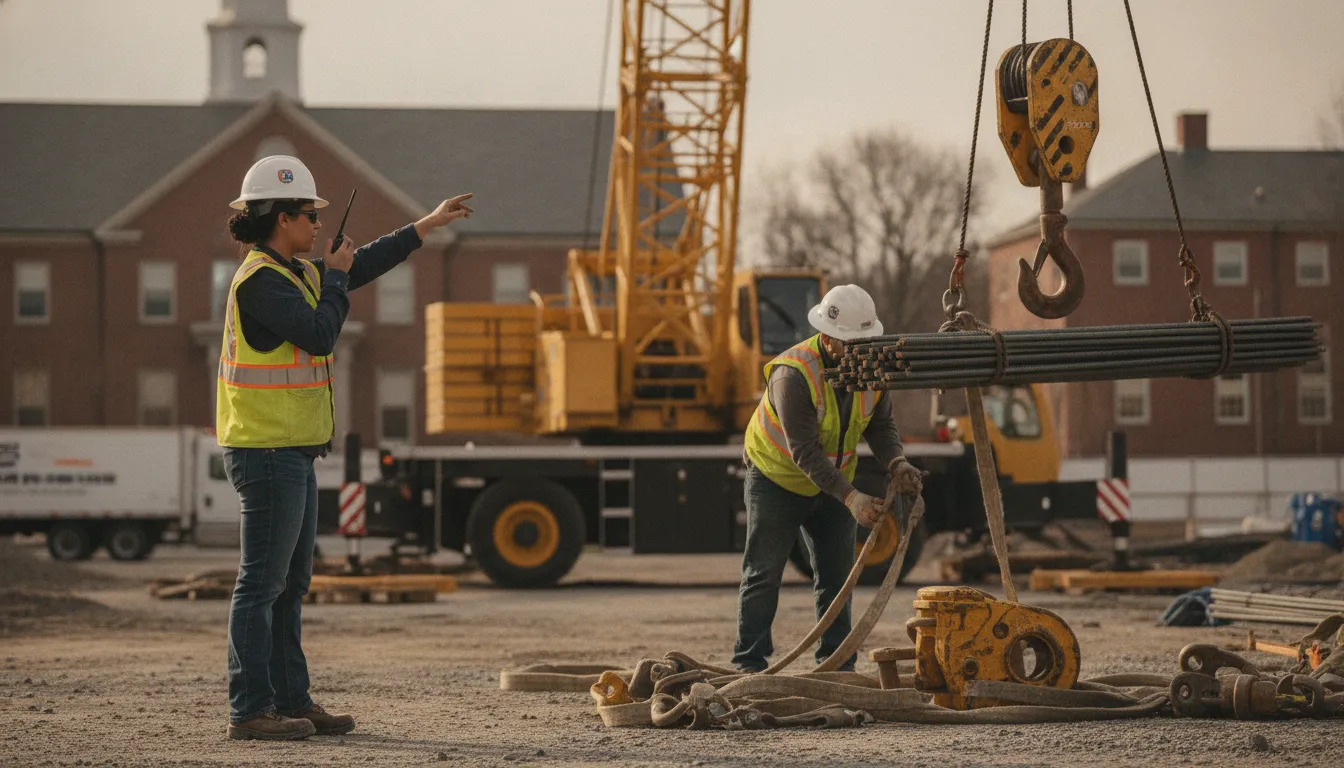
These roles can work together on the same lift, but they are not interchangeable. A rigger prepares and connects the load. A signal person communicates with the operator when the operator cannot see the load path or work area clearly. A Massachusetts hoisting-license holder operates covered equipment within the scope of the license and applicable site rules. One person may hold more than one qualification, but that overlap must be established through the correct training, evaluation, and employer authorization.
OSHA defines a qualified rigger by the combination of training, knowledge, and experience needed to perform the assigned work safely. OSHA also addresses cranes and derricks in 29 CFR 1926 Subpart CC. Its 29 CFR 1926.251 standard covers rigging equipment used for material handling. The practical distinction is more useful than the job title alone. Use this comparison.
How common lifting roles differ.
| Role |
Primary responsibility |
What the credential or qualification addresses |
| Rigger |
Inspect, select, attach, and control slings, hooks, and other lifting accessories for the assigned load and lift plan. |
Rigging knowledge, load-handling judgment, equipment limitations, hazard recognition, and practical ability. OSHA does not require one universal rigger certificate, but the employer must ensure the person is qualified for the work. |
| Signal person |
Give clear, agreed-upon directions to the equipment operator and maintain effective communication during the lift. |
Knowledge of required signals, communication methods, site hazards, and the ability to direct the operation safely. A project or employer may require a formal evaluation or third-party credential. |
| Massachusetts hoisting-license holder |
Operate equipment covered by the holder's Massachusetts classification, subject to current state rules, equipment limits, and employer procedures. |
State licensing under the Massachusetts framework. Classifications include Class 1 hoisting equipment, Class 2 excavating equipment, Class 3 special equipment, and Class 4 specialty operations. |
The table is a decision aid, not a substitute for the lift plan or current requirements. A Massachusetts hoisting license does not automatically make someone a qualified rigger or signal person. Likewise, rigging certification does not automatically authorize a worker to operate every crane, excavator, or other hoisting device. Confirm the equipment, load, assigned duties, communication method, and employer or project requirements before work begins.
For the state-license side of that review, compare the applicable Massachusetts hoisting license classifications. For role-specific rigging work, the employer should document how the worker was trained and evaluated, and whether the qualification applies to the equipment and conditions on the jobsite. That distinction helps workers pursue the right path and helps contractors avoid treating one credential as a blanket authorization.
When Do You Need a Formal Rigging Credential?
A formal rigging certification can be useful when a contractor, public project, union, insurer, or employer needs documented evidence that a worker has been assessed for specific rigger or signal-person duties. It is not automatically required for every lift. And it does not replace Massachusetts hoisting licensing when a job involves equipment or operations covered by the state licensing framework. Start with the work being assigned, then confirm which qualification the employer or project actually recognizes.
OSHA's focus is qualification for the work, not one universally required rigger certificate. OSHA describes a qualified rigger as someone with the combination of training, knowledge, and experience needed to perform the necessary tasks safely. Its material-handling requirements in 29 CFR 1926.251 are one important reference point. A company may therefore qualify a worker through documented training, demonstrated ability, relevant experience, and job-specific evaluation. The employer remains responsible for making sure the person assigned to the lift can perform the work safely.
When third-party assessment adds value
Choose a formal third-party credential when the project specification calls for one or when a general contractor requires one before site access. It can also help when your company needs a consistent qualification record across multiple crews and locations. Third-party testing makes a worker's preparation easier to document when duties involve complex lifts, frequent crane work, or coordination with multiple employers.
NCCER offers separate Rigger, Advanced Rigger, and Signal Person certification categories. Its program describes assessments and practical exams aligned with ASME B30 and OSHA 29 CFR Part 1926 Subpart CC. And it states that these certifications are delivered through NCCER Accredited Endorsed Assessment Programs. Read the details at NCCER's rigger and signal-person certification page. That information can help you compare the assessment scope with the duties you will perform. But it does not make NCCER the best or only option for every worker.
The Iron Workers provide another neutral example of a third-party model. Their program describes training, testing, record keeping, and recertification, and notes that contractors, states, and municipalities may request or require a qualified-rigger or signal-person certification. Its eligibility rules and assessment structure may not match your employer's plan, so review the applicable requirements at the Iron Workers certification program page rather than assuming they apply to your job.
Before enrolling, ask four questions: What equipment and duties will I perform? Does the project require third-party testing? Will my employer accept an employer qualification instead? Do I also need a Massachusetts hoisting license for the equipment I will operate? Keep the answers and supporting records together. A credential is useful only when its scope matches the lift, the role, and the requirements controlling that jobsite.
How Should an Employer Build a Rigging Qualification Plan?
A useful rigging qualification plan connects the worker, the equipment, the load, and the jobsite. It should not treat a general rigging certification or a Massachusetts hoisting license as automatic authorization for every lift. OSHA describes a qualified rigger in terms of the combination of training, knowledge, and experience needed to perform the assigned work safely. Employers should document how each person meets that standard for the duties they will actually perform.
- Identify the equipment and loads. List the cranes, hoists, forklifts, overhead cranes, slings, below-the-hook devices, and other equipment used by the crew. Describe the load types, weights, shapes, attachment points, travel paths, and nearby hazards. Match the plan to the actual work, not a generic job title.
- Assign specific duties. Decide who will rig the load, who will give signals, who will operate the equipment, and who has authority to stop the lift. A signal person, rigger, and hoisting-license holder may be different people. Write down where responsibilities begin and end, especially when the lift requires hand signals, radios, or a designated spotter.
- Verify training and experience. Review relevant course records, practical experience, employer evaluations, and any project or contractor credential requirements. Include training on load-chart interpretation, hazard recognition, hand-signal communication, emergency response, and site-specific planning. If the work involves cranes and derricks, review applicable OSHA requirements under Subpart CC. Do not assume that one credential covers every equipment type or role.
- Set communication and lift procedures. Establish the communication method before work starts. Define standard signals, radio language, signal-person positioning, blind-lift procedures, exclusion zones, weather limits, and the stop-work command. Require a pre-lift discussion when the load, route, equipment, or crew changes.
- Build inspection and removal rules. Under OSHA 1926.251, rigging equipment must be inspected before use on each shift and as necessary during use. Defective equipment must be removed from service. The rule also requires legible safe-working-load markings, and equipment cannot be loaded beyond its recommended capacity. Assign who performs inspections and where records are stored.
- Keep qualification records current. Maintain worker names, assigned duties, equipment covered, training dates, practical evaluations, authorization limits, refresher needs, and copies of certificates. Review the file when equipment or procedures change, after an incident or near miss, and when a worker takes on a new role. For a crew-based program, onsite rigger and signal person training can align instruction with the worksite. Employers may also review approved in-house equipment training for specified hoisting equipment on company property.
Business Owner Note: A written plan gives supervisors one clear way to confirm who is trained, what each worker may do, and when a lift must stop for review.
How Do You Choose Rigging Training in Massachusetts?
The right training path depends on what you will operate, what you will do around the load, and what your employer or project requires. Start by identifying the equipment classification and your role before choosing a course. A person operating hoisting equipment may need Massachusetts license preparation, while a rigger or signal person may need separate employer qualification or a role-specific credential.
Use this process to narrow the options:
- Match the equipment to the classification. Write down the equipment you will operate or support, including the type of boom, crane, excavator, loader, or other lifting equipment. Massachusetts classifications cover Class 1 hoisting equipment, Class 2 excavating equipment, Class 3 special equipment, and Class 4 specialty operations. Review the current Massachusetts license classifications before enrolling.
- Define your job duties. Will you operate the equipment, attach and inspect rigging, direct the load, communicate with the operator, or perform several of these functions? Training should address the actual work. Look for instruction covering inspection, load-chart interpretation, hand signals, hazard recognition, emergency response, and site-specific planning. Do not assume a hoisting license automatically qualifies you for every rigger or signal-person assignment.
- Choose the format that fits the work. Online preparation can help an individual study around a work schedule. Classroom instruction may be better when you need an instructor to explain equipment classifications and test topics in real time. MA Hoisting License offers classroom and online preparation associated with classifications such as 1B, 1C, 2A, and 3A/1D. For a local classroom option, review the 2A and 1C classroom test preparation course.
- Consider onsite training for employer-specific work. If the crew uses consistent equipment and procedures, onsite instruction can connect the training to the employer's lifting plan and documentation process. Ask whether the provider can address rigger and signal-person duties as well as operator preparation, rather than selecting a general course that leaves role boundaries unclear.
- Confirm the current rules before you register. Massachusetts hoisting licensing is overseen by OPSI under Chapter 146 and 520 CMR 6.00. Requirements and continuing education can vary by classification, so license holders should review current OPSI guidance and the provider's Massachusetts hoisting continuing education information. Finally, get written confirmation from your employer, general contractor, or project manager about required credentials, practical evaluations, records, and site orientation.
If the classification or role is still unclear, gather the equipment model, expected duties, work location, and employer requirement before asking a training provider for direction. That information makes it easier to select preparation that supports the work you are actually authorized and expected to perform.
What Should You Verify Before Starting Rigging Work?
A safe lift begins before the load leaves the ground. Use a final pre-work check to confirm that the equipment, load information, people, and work area are ready for the planned operation. Site conditions and employer procedures matter, so this checklist should support, not replace, your company's lift plan, hazard assessment, or supervisor instructions.
Inspect every piece of rigging
Check slings, hooks, shackles, chains, wire rope, synthetic webbing, fasteners, and other attachments before use. Look for cuts, broken wires, stretched links, bent or cracked hardware, heat damage, chemical damage, worn stitching, missing components, and any other condition that could affect safe use. OSHA 29 CFR 1926.251 requires rigging equipment to be inspected before use on each shift and as necessary during use. Slings and their fastenings and attachments must be inspected each day by a competent person designated by the employer. If equipment is damaged or defective, remove it from service immediately. Do not try to make a questionable item work for one more lift.
Also confirm that identification markings are present and legible. The marking should show the manufacturer's recommended safe working load. Equipment must not be loaded beyond that limit or used when required markings are missing. Read the full OSHA 29 CFR 1926.251 standard for the applicable requirements.
Confirm the load and capacity
Identify the load's weight, center of gravity, dimensions, attachment points, and any sharp edges or unusual shape. Match that information to the capacity of the sling configuration, hardware, lifting device, and hoisting equipment. Verify the load chart or manufacturer information before connecting anything. If the weight or capacity is unknown, stop and obtain reliable information from the responsible supervisor or engineer. Never estimate a critical load from appearance alone.
Plan communication and the exclusion zone
Agree on who directs the lift, which signals or radio protocol will be used, and how the operator will receive a stop signal. Everyone involved should understand the sequence, blind spots, travel path, and emergency response. Establish an exclusion zone before the lift begins. Keep people clear of suspended loads, pinch points, swing areas, and locations where a shifting load could strike them. Reassess the zone if weather, access, nearby work, or the load path changes.
Verify people and records
Confirm that the assigned worker is qualified for the specific rigging duties, based on the required training, knowledge, experience, and employer authorization. A rigging certification may support that decision, but it does not automatically cover every task or jobsite. Confirm any project, contractor, or municipal credential requirement separately. Record inspections, defects, removals from service, corrective actions, and worker qualifications according to employer procedures. If any answer is unclear, pause the lift and escalate it before work starts.
Call 508-212-4735 to review your rigging certification and training options.
Frequently Asked Questions
How do you become a certified rigger in Massachusetts?
Start by identifying the work you will perform, the equipment involved, and whether your employer or project requires a third-party credential. OSHA focuses on whether a rigger is qualified through the right combination of training, knowledge, and experience, rather than naming one universal rigger certificate. Review the applicable employer requirements, complete relevant training, and document any required assessment or practical evaluation. OSHA guidance should be checked alongside current site requirements.
Does a Massachusetts hoisting license make you a qualified rigger?
Not automatically. A Massachusetts hoisting license addresses state-regulated equipment classifications overseen by the Office of Public Safety and Inspections under Chapter 146 and 520 CMR 6.00. Rigging and signaling duties may require separate training, demonstrated skills, employer authorization, or a project-specific credential. Match the license classification to the equipment and review the actual duties before assuming one credential covers the entire lift team.
Is NCCER rigger certification required for every job?
No single private credential is required for every job. Employers, contractors, municipalities, and project owners may set additional requirements. NCCER describes separate Rigger, Advanced Rigger, and Signal Person certifications that use assessments and practical exams through accredited endorsed assessment programs. Confirm the credential named in the employer or project specification before selecting a course. NCCER explains its certification categories.
What should an employer document for rigging qualification?
Document the worker's assigned duties, equipment and load types, training, practical evaluation, communication procedures, inspection expectations, and any required credential or renewal record. The plan should also explain who may rig, signal, or direct a lift. For a Massachusetts crew, compare the plan with current OSHA requirements and the applicable hoisting classifications before work begins.
Ready to Choose the Right Rigging Training?
Rigging duties, signal-person responsibilities, and Massachusetts hoisting-license needs can overlap, but they are not always the same. A quick review of your equipment, job duties, and employer requirements can help you select training that fits the work you perform.
Call MA Hoisting License at 508-212-4735 to match your role and equipment with an appropriate training path.
Tags: ,